





Key Takeaways
How long will my child cry after drop-off?
Most children calm down within 10–20 minutes after you leave.
What is the best way to handle saying goodbye during daycare drop-offs?
Build a brief, consistent routine with the same steps every single day. Do not linger, and never sneak out behind their back.
How many weeks does the daycare adjustment period usually last?
Most children settle into the daycare routine within 1–4 weeks. Crying at drop-off for several weeks is completely developmentally normal.
How can one tell if a child’s daycare transition is going well?
The transition is going fine if your child is happy at pickup and is eating and sleeping reasonably well, even if mornings are tough.
The first day at childcare is a milestone that most parents dread more than their child does. You’ve spent weeks (or months) asking the right questions, touring centers, and filling out enrollment forms. You’ve found a place you trust. And now you’re standing at the drop-off door wondering if you’ve made a terrible mistake.
You haven’t. But the first day — and the first few weeks — takes adjustment. For your child, and for you. Knowing what to expect makes both easier.
Before the first day, make sure you’ve asked the center the practical questions that matter — their sick policy, communication method, and daily schedule. If you haven’t done that yet, questions to ask a childcare provider covers everything worth knowing before enrollment.
What to Expect on Your Child’s First Day at Childcare
The first day at childcare is a transition milestone — one that typically involves tears at drop-off, genuine recovery 10–20 minutes later, and an adjustment period that lasts anywhere from a few days to a few weeks depending on the child.
Here’s what research and experienced childcare professionals consistently observe: children’s stress response at drop-off peaks in the moment of separation. Once you leave, most children calm down relatively quickly — especially when a skilled teacher redirects them into activity. What lingers is not the distress you see at drop-off, but the daily practice of separation, which becomes easier as the routine becomes familiar.
The American Academy of Pediatrics notes that separation anxiety peaks between 9–18 months and can resurge around ages 2–3 during major transitions. A first day at childcare often happens right in this developmental window — which is why it can feel so acute, especially for babies and toddlers.
The center is prepared for this. Your child is not the first to cry. The teachers have transition strategies that work. Your job is a short, confident goodbye — which turns out to be the single most helpful thing a parent can do.
What Should You Pack for the First Day?
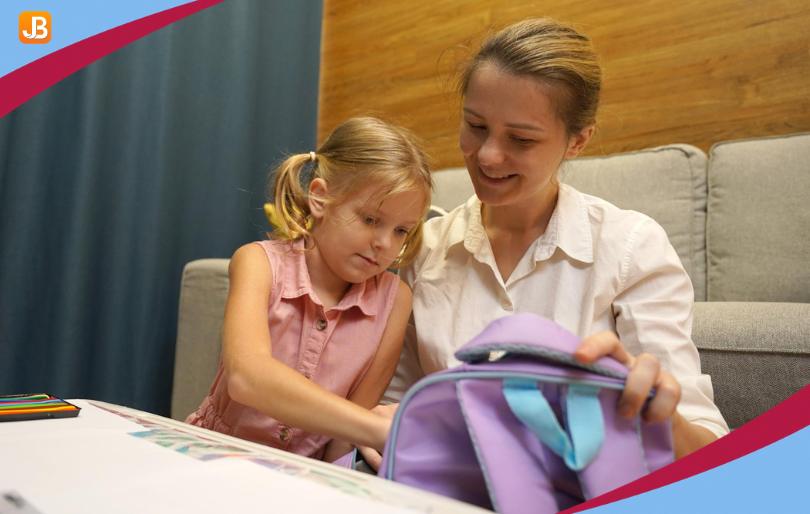
Label everything. This is not optional. In a room of 10 toddlers, every bottle, every sock, every pacifier looks the same. Use a waterproof label maker or a permanent marker on everything that enters the building.
What to pack:
- Clothing: 2–3 complete changes (top, bottoms, socks). Assume at least one outfit will come home wet or dirty.
- Diapers and wipes: A full day’s supply, clearly labeled with your child’s name.
- Feeding: Bottles pre-filled or pre-measured (for infants), sippy cups, any snacks or food if the center doesn’t provide meals. Check the center’s policy on what they supply.
- Sleep item: For infants, a labeled sleep sack. For toddlers, a small blanket or nap mat (confirm what the center accepts — many have specific requirements for safe sleep compliance).
- Comfort item: One small stuffed animal or comfort object that smells like home. Many centers have a policy on comfort items in group settings — ask in advance.
- Any medications or medical supplies: With written authorization forms filled out and signed. Bring the medication in its original packaging.
- Completed forms: If the center hasn’t already collected emergency contacts, signed policies, and immunization records through the enrollment process, bring them on day one.
Your center may have a specific packing list — ask for it at orientation if they didn’t include one in the enrollment packet.
How Do You Prepare Before the First Day?
A few days before the first day, start shifting your child’s routine toward the center’s schedule. The two most impactful adjustments:
Meal timing. If the center serves lunch at 11am but your child usually eats at 12:30, start moving lunch earlier. Hunger on a disrupted schedule adds unnecessary stress to an already challenging transition.
Nap timing. The same logic applies to nap. If your child’s nap start time differs significantly from the center’s scheduled rest period, begin shifting it by 15–20 minutes per day in the week before.
If the center offers a transition visit — a brief visit with a parent present before the official start — take it. Familiar faces and a familiar space reduce the shock of the first official drop-off. Not all centers offer this, but it’s worth asking.
Talk to your child about it in age-appropriate terms in the days before. Toddlers and preschoolers benefit from knowing what’s coming — “tomorrow you’re going to school, and I’ll pick you up after snack time.” Infants don’t need the verbal preparation, but parents do.
What Should Drop-Off Look Like?
The drop-off goodbye is the moment that matters most — and most parents instinctively do it in a way that makes it harder.
Build a consistent, brief goodbye ritual. Two or three steps, the same every drop-off, every day. It might be: hug, kiss on the head, “I love you, I’ll see you at pickup.” Then you hand off to the teacher and leave. The ritual signals that this is a safe, expected transition — not a crisis.
Say goodbye clearly. Don’t sneak out. Sneaking out feels kinder in the moment but erodes trust over time. Your child needs to learn that when you say goodbye, you really go — and you always come back. That’s the lesson. A child who discovers a parent disappeared without warning learns to be hypervigilant at drop-off, not more relaxed.
Don’t linger. The longer a goodbye takes, the harder it is. A crying child who is held for an extra five minutes doesn’t calm down — the extended goodbye confirms that something difficult is happening. A warm, confident goodbye followed by an immediate handoff lets the teacher take over, which is what needs to happen.
Project confidence even when you don’t feel it. Children are highly attuned to parental emotional state. Your uncertainty transfers directly. A calm, cheerful “see you soon!” — even if you cry in the car — is the right performance.
How Long Does Adjustment Take?
Most children settle into a childcare routine within 1–4 weeks. Some adjust in a few days; some take 6–8 weeks. The range is wide and normal.
What adjustment actually looks like:
- Week 1: Crying at drop-off, recovery after 10–20 minutes, possibly disrupted sleep or appetite at home
- Weeks 2–3: Drop-off may still involve tears but recovery time shortens; children begin recognizing teachers and anticipating routine
- Weeks 3–4: Most children have found their footing — they may still be sad at goodbyes but can be redirected quickly. Happy pickups become the norm.
Zero to Three, an early childhood development organization, notes that adjustment timelines vary significantly by temperament. A child with a slow-to-warm temperament may take longer than a child who adapts quickly to new environments — and that’s not a sign that something went wrong.
The indicators that matter: Is your child happy at pickup? Eating reasonably? Sleeping? If yes, the transition is going well even when mornings are difficult. The measure of adjustment isn’t drop-off — it’s the rest of the day.
If your child is consistently inconsolable during pickup, not eating, or showing significant behavioral regression after several weeks, talk to the center director and your pediatrician.

What Is the Center Doing While You’re Away?
Once you leave, experienced teachers redirect your child into activity. This is not distraction — it’s genuine engagement that shifts the child’s attention from the stressful moment to something interesting and safe.
Most well-trained childcare staff follow a consistent approach:
- Acknowledge the child’s feelings (“I know you’re sad, that’s okay”)
- Offer comfort without reinforcing distress (holding briefly, then redirecting)
- Move the child toward an activity, a familiar object, or another child
- Follow the daily schedule, which provides the predictability children need to settle
Teachers in infant and toddler rooms are specifically trained for this — it’s the most emotionally demanding part of the job. Your child is not a disruption to their day. Transition support is part of what they’re there to do.
How Will the Center Communicate With You?
A well-run center sends a daily report for each child — what they ate, how long they slept, what activities they did. For infants, this typically includes feeding times, diaper changes, and sleep times. For toddlers and preschoolers, it includes activities and how the day went overall.
Ask your center on day one: how do I receive daily reports? The format varies — a written paper sheet at pickup, a parent communication app, or a brief verbal summary from the teacher. Centers using childcare registration software can often send digital daily reports to parents in real time, which is particularly helpful on anxious first weeks when a parent wants to know how the morning went without calling.
If you’re worried during the day, it’s completely reasonable to call the center and ask how your child is doing. Most centers welcome the call and have a quick answer. Don’t call every hour — that makes it harder for staff to focus — but once in the morning is appropriate on early days.
FAQ
Is it normal for my child to cry every morning at daycare drop-off?
Yes, especially in the first 1–4 weeks. Crying at drop-off is developmentally normal, particularly for children between 9 months and 3 years. The key indicator is not drop-off behavior but what happens afterward — most children calm within 10–20 minutes and are happily engaged at pickup.
How long does it take for a child to adjust to childcare?
Most children settle into the routine within 1–4 weeks. Children with slow-to-warm temperaments may take 6–8 weeks. If significant distress continues beyond 8 weeks — particularly at pickup or with behavioral regression — speak to the director and your pediatrician.
Should I sneak out at daycare drop-off?
No. Sneaking out avoids the immediate tears but erodes your child’s trust over time. They need to learn that you say goodbye and then you leave — and that you always come back. A brief, warm, consistent goodbye is harder in the moment but builds the secure routine faster.
What should I do if the daycare calls me to come back?
If your child is inconsolable beyond the normal adjustment period or becomes ill, the center will call. Come when they ask. If the calls happen repeatedly in the early weeks for reasons that don’t involve illness, talk to the director about whether additional transition support or a modified start schedule might help.
How do I prepare my toddler for their first day at daycare?
A few days before, shift meal and nap times toward the center’s schedule. Talk about it simply (“Tomorrow you’re going to school — I’ll pick you up after snack time”). Bring one comfort item from home. Build the goodbye ritual on day one and use it consistently from that point on.
Conclusion
Your child’s first day at childcare is a big moment for your family — and it’s usually harder for you than for them. Most children settle quickly once a parent leaves. Most find their footing within a few weeks. The center is prepared for this transition and so, now, are you.
A consistent goodbye, a good packing routine, and realistic expectations about the adjustment timeline are the three things that make the biggest difference. The rest is patience.
Once the transition is behind you and your child is settled, the full value of a quality childcare program becomes clear. The benefits of childcare — for your child’s development and socialization, and for your family — are worth every hard morning.