




Key Takeaways
- Team building activities for sports are 5-to-20-minute practice games that build names, communication, trust, and shared goals.
- Match the activity to age: names for 5 to 8, trust for 9 to 12, ownership for teens.
- Match it to the season moment — preseason, a slump, a loss, or a conflict.
- Run one a week, and debrief each for two minutes.
Last updated: October 2026
It’s week three. Your U10 team passes only to the two kids they know from school, and nobody can tell you the new kid’s name. So what do you do when a team is a roster but not a team yet? Team building activities for sports are short, structured games and exercises — usually 5 to 20 minutes, run during practice — that help players learn each other’s names, communicate under pressure, trust teammates, and agree on shared goals, followed by a quick debrief that connects the activity to how the team plays.
What Are Team Building Activities for Sports?
Team building activities for sports are short, structured games — usually 5 to 20 minutes during practice — that help players learn names, communicate, trust each other, and agree on shared goals. The best ones use a ball or field skill, mix friend groups, and end with a quick debrief that links the game to how the team plays.
Each good activity builds at least one of four things:
- Names and connection — players know every teammate, not only their carpool.
- Communication — kids call for the ball out loud.
- Trust — players count on a teammate after a mistake.
- Shared goals — the team agrees on what it’s playing for.
My rule of thumb: pick games that use a pass, a call, or a position. The lesson shows up faster on Saturday.
Why Is Team Building Important for Youth Sports Teams?
Team building matters because friendship and fun are why kids play. In the Aspen Institute Project Play 2026 national youth survey, 47% of young athletes named playing with friends as a top reason they play. A team where kids know and trust each other is more fun, communicates better on the field, and keeps players coming back next season.
Sport psychologists split team cohesion into two parts:
- Task cohesion — agreeing on how we play: roles, effort, the game plan.
- Social cohesion — liking each other: names, inside jokes, sitting together on the bench.
Social-only teams have fun losing 8–0; task-only teams splinter after one bad loss. Good team building activities for youth sports work on both.
Skip it, and the cost shows up in dropout numbers. A 2019 survey from Aspen Institute Project Play and Utah State University found the average child quits a sport by age 11 — most often (36% of the time) because they stopped enjoying it.
That’s a league problem, too. If you’re working out how to start a youth sports league, put team culture in the plan next to fields and referees — families come back where their kids had friends.
What Team Building Activities for Sports Work for Ages 5 to 8?
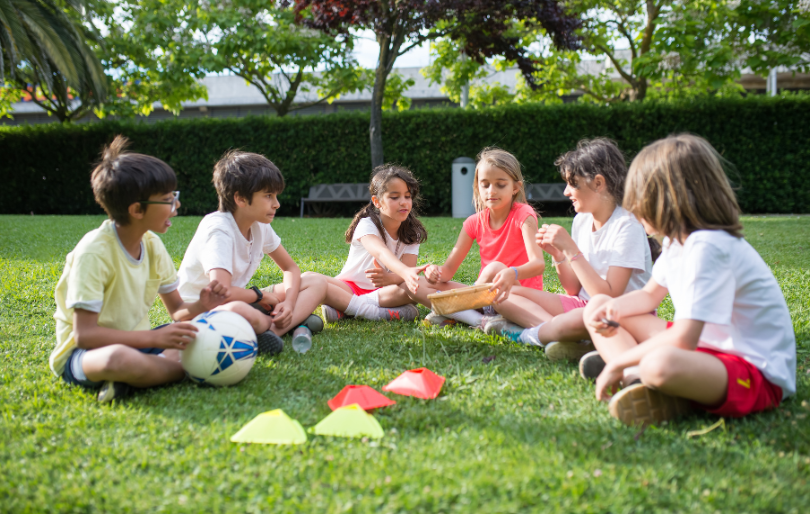
For ages 5 to 8, use short, high-movement games that teach names and simple cooperation: Name Pass, Hula Hoop Pass, Mirror Me, and making a team name and cheer. Keep each one under 10 minutes, skip anything with winners and losers among teammates, and repeat favorites weekly — young kids learn through repetition.
| Activity | How it works | Time | Equipment | What it builds |
|---|---|---|---|---|
| Name Pass | Say a teammate’s name, then pass them the ball | 5 min | 1 ball per circle | Names |
| Hula Hoop Pass | Hands joined, pass a hoop around the circle | 5 min | 1–2 hula hoops | Cooperation |
| Mirror Me | One partner moves, the other copies, then swap | 3 min | None | Watching a teammate |
| Team Name and Cheer | Pick a team name and a short pregame cheer | 5–10 min | None | Belonging |
My pick for a first practice is Name Pass — it doubles as a warm-up. If your 6-year-olds still say “hey you” by week two, open every practice with it.
Trust falls? Skip them at this age, along with blindfold games. Fun team building activities for sports teams this young should feel like recess with a ball.
What Team Building Activities Work for Ages 9 to 12?
Ages 9 to 12 are ready for problem-solving and trust games that force communication: Human Knot, Minefield, the Pass-Count Challenge, and Tarp Flip. This is the age when cliques form, so assign partners and groups yourself. Plan 10 to 15 minutes and tie each game to a field skill like calling for the ball.
| Activity | How it works | Time | Equipment | What it builds |
|---|---|---|---|---|
| Human Knot | Grab hands across a circle, then untangle | 10 min | None | Communication |
| Minefield | Blindfolded player crosses cones guided by a partner’s voice | 10–15 min | Cones, blindfolds or pinnies | Trust |
| Pass-Count Challenge | 15–20 straight passes; everyone touches the ball | 10 min | 1 ball, cones | Calling for the ball |
| Tarp Flip | Flip a tarp while the whole team stands on it | 10–15 min | 1 tarp | Planning |
| Slow Motion Tag | Tag in slow motion; speeders do five jumping jacks | 5 min | Cones | Laughing together |
If your 9-to-12 team has split into cliques, assign Minefield partners across friend groups. One U10 coach did that in week three; by week five, the two school-friend groups were calling for the ball across groups. (Run Minefield on open grass, away from goals and benches.)
What Team Building Activities Work for Teen Athletes?
Teen athletes respond best to activities that give them ownership: player-led goal setting, team norms written by the players, appreciation circles, and challenge builds like Duct-Tape Skis. Teams of 15-to-20-year-olds showed the largest cohesion gains from team building in a 2024 meta-analysis by Kwon in Frontiers in Psychology (effect size 0.88, versus 0.48 under age 15), so this is the age where the time pays off most.
| Activity | How it works | Time | Equipment | What it builds |
|---|---|---|---|---|
| Goal-Setting Session | Players propose season goals, then vote on two or three | 20 min | Whiteboard | Shared goals |
| Team Norms Draft | Players write how teammates treat each other | 15–20 min | Paper, markers | Ownership |
| Appreciation Circle (Hot Seat) | Each player hears one specific thing a teammate values | 10–15 min | None | Trust |
| Duct-Tape Skis | Groups of four “ski” across a grid on two boards | 10–15 min | 2 boards, tape or straps | Timing |
| Service Project or Film Night | Volunteer together or watch game film | 1–2 hrs, off-field | Varies | Off-field bonds |
If your high schoolers roll their eyes at games, hand them the marker instead. One varsity team wrote its own norms the Monday after a blowout loss — “no sulking on the bench” — and enforced them all season. Team bonding ideas for sports teams land best when players help plan them.
When Should You Use Team Building Activities During the Season?
Use team building activities on a schedule, not only in a crisis. Kwon’s 2024 meta-analysis in Frontiers in Psychology found that programs shorter than two weeks didn’t measurably improve cohesion, while multi-week programs did. Front-load name and connection games in preseason, add communication games early, then use resets mid-season, after losses, after conflicts, and at season’s end.
| If your team is… | Use… |
|---|---|
| In preseason or the first 2 practices | Name games (Name Pass, Team Name and Cheer) |
| In the early season | Trust games (Minefield, Pass-Count Challenge) |
| In a mid-season slump | Something silly (Slow Motion Tag, a mixed-position scrimmage) |
| Coming off a tough loss | An Appreciation Circle or “one thing we did well” |
| Split by a conflict or cliques | A coach talk first, then assigned-partner tasks |
| At season end | A celebration and effort awards |
Fitting it in is easy: one activity per week, as the warm-up or in the last 10 minutes. If you’re still figuring out how to coach your child’s sports team, treat that slot like any other block in your practice plan — written down and timed.
How Do You Debrief a Team Building Activity in 2 Minutes?
Debrief by gathering the team right after the activity and asking three or four short questions: What did we do? What helped us succeed? What got in the way? Where will this show up in our next game? Keep it to two minutes, let players answer first, and end with one concrete takeaway.
- What did we do? Facts first.
- What helped us succeed? Ask for names, not “teamwork.”
- What got in the way? Let kids name the problem.
- Where will this show up in our next game? Close with one behavior, like “call a name before every pass.”
| Age band | Sample question |
|---|---|
| 5 to 8 | “Who helped you? Thumbs up if a teammate said your name.” |
| 9 to 12 | “What did you have to say out loud to make it work?” |
| Teens | “Which of our team norms showed up? Which didn’t?” |
Skip the debrief, and the game stays a game.
How Can League Organizers Make Team Building Part of Every Season?
League organizers can make team building standard by giving every coach a one-page plan — two activities per age band, the season timing table, and the debrief questions — during coach onboarding. Then free up coaches’ time by handling rosters, schedules, and family messaging centrally, so practice time goes to players, not paperwork.
Start with new-coach training. When you recruit and train volunteer coaches, hand out the one-pager with the practice-plan template and run one activity live.
Running registration, rosters, practice schedules, and coach-to-family messaging league-wide through sports management software takes that admin off their plate.
FAQ
What are 5 team building activities for sports teams?
Name Pass (ages 5 to 8), Human Knot (9 to 12), Minefield (9 to 12), the Pass-Count Challenge (9 and up), and an Appreciation Circle (teens). Each takes 5 to 15 minutes. Run one per week and debrief each for two minutes.
What are some fun team building activities for young athletes?
Hula Hoop Pass, Mirror Me, and Slow Motion Tag work well because they’re short, silly, and nobody gets knocked out. Keep each under 10 minutes and repeat the favorites — young kids enjoy a game more the second time.
How do you build trust on a sports team?
Build trust with assigned partners, voice-guided games like Minefield, and a coach who follows through. Pair players across friend groups, and keep your own promises. Kids trust teammates faster when the adult in charge is predictable.
What are good indoor team building activities for sports teams?
For rain days or gym practices, use Human Knot, Tarp Flip, an Appreciation Circle, or a goal-setting session. None needs more than a tarp or a whiteboard, and all fit a gym corner or locker room.
How often should a sports team do team building activities?
Once a week, all season, for 5 to 20 minutes. A 2024 meta-analysis in Frontiers in Psychology found multi-week programs, not one-off sessions, are what change how a team works together. A single bonding day fades fast.
Conclusion
Team building activities for sports work best when you match them to your players’ age, use them at the right moment in the season, and close every one with a two-minute debrief.
So start small this 2026–2027 season: pick one activity for your age group, run it as next practice’s warm-up, and debrief. Then watch who your quietest player passes to on Saturday.