




Key Takeaways
- Camp skits are one- to three-minute comedy scenes performed at campfire, assemblies, skit night or on rainy days.
- Pick no-props skits with a cast of four to eight and one clear punchline.
- Cap every skit at three minutes and keep the whole show near 45 minutes.
- Write a no-put-downs rule and pre-screen every skit, counselor skits included.
- Give shy campers a real role that doesn’t need a solo line.
Last updated: October 2026
It’s 9:15 p.m. at the fire circle. Cabin 7’s skit is in its eighth minute, half the 6-year-olds are asleep on the benches, and a counselor has landed a big laugh with a joke about one camper’s haircut while that camper stares at the ground. Camp skits are supposed to be the best part of the night. So how do you run them so the show ends on time, every joke lands kindly, and the quietest kid in cabin 3 still gets on stage?
Here’s the playbook I’d hand any program lead for 2027: place, pick, run, screen, include.
What Are Camp Skits?
Camp skits are short, mostly improvised comedy scenes, usually one to three minutes long, that cabin groups or counselors perform for the rest of camp at a campfire, an all-camp assembly or a dedicated skit night. Most are folk material passed from camp to camp, need no props, and build to a single punchline.
That folk part matters. Nobody owns the invisible bench. Published scripts and skit books do belong to someone, though, so teach premises, not photocopied pages. Let campers write their own lines. Funnier anyway.
Where Do Camp Skits Fit in Your Program?
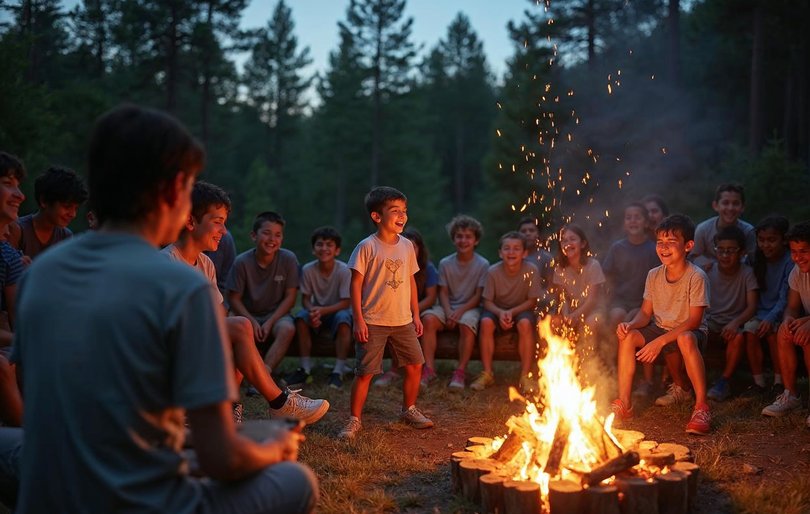
Camp skits fit in four places: the evening campfire, an all-camp assembly, a dedicated skit night and the rainy-day schedule. Each slot asks for a different length and energy level, so match the skit to the setting instead of running the same 12-minute production everywhere.
| Setting | Skit length | How many | What works |
|---|---|---|---|
| Evening campfire | 1–2 minutes | 3–5, mixed with songs | Loud, physical, quick punchline |
| All-camp assembly | Under 1 minute | 1–2 as openers | Run-ons, counselor walk-ons |
| Skit night | Up to 3 minutes | One per cabin | Rehearsed cabin skits |
| Rainy day | 2–3 minutes | Workshop, then perform | Write-your-own skits |
Campfire skits do best early, while the fire is high and kids are loud. As the flames drop, switch to songs and campfire stories for kids so the night winds down instead of ending on a shout.
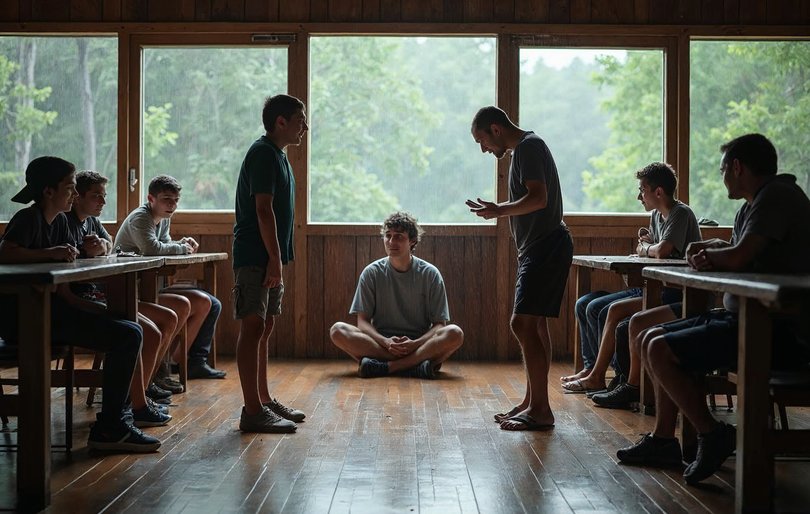
Rain turns skits into a full program block. Give each cabin 40 minutes to write and rehearse in the dining hall, then perform after lunch. Few indoor summer camp activities fill an afternoon with zero equipment.
What Are the Best Easy Camp Skits for Kids?
The best easy camp skits need no props, use a cast of four to eight, and build to one clear punchline in under three minutes. Classic folk skits work because campers already half-know them, so rehearsal takes ten minutes and every cabin can bend the premise around its own jokes.
Here are 12 camp skit ideas I’d put in any skit bank. Premises only. Your campers write the lines.
| Skit | Premise in one line | Cast | Props | Best ages |
|---|---|---|---|---|
| We Don’t Have a Skit | A group panics on stage about forgetting to plan a skit, then walks off, having performed exactly that | 4–8 | None | All |
| Invisible Bench | Campers sit one by one on a bench that isn’t there until someone points out the problem | 4–6 | None | 8+ |
| Echo Canyon | A hiker shouts into a canyon, and the “echo” starts answering back with its own opinions | 2–3 | None | 7+ |
| Redo the Scene | A director keeps yelling “cut” and makes actors replay a tiny scene as a soap opera, in slow motion, as robots | 4–6 | None | 9+ |
| Channel Surfing | A narrator “changes channels” and groups jump between a cooking show, a weather report and a nature documentary | 5–8 | None | 9+ |
| Wax Museum | A tour guide shows off statues that move whenever the visitors turn their backs | 4–8 | None | All |
| Instant Replay | Campers act out a dramatic camp moment, then replay it in slow motion and rewind | 4–6 | None | All |
| The Great Mind Reader | A “mind reader” guesses audience-picked objects, thanks to a not-so-subtle assistant | 2–3 | None | 9+ |
| Fishing in the Pool | Campers cast imaginary lines with total focus until a lifeguard points out where they’re standing | 3–5 | None | All |
| Human Machine | Campers join one by one, each adding a sound and motion, until the “machine” breaks down | 6–10 | None | All |
| Sound-Effects Story | A narrator tells a short story while the cabin supplies every creak, storm and footstep | 5–10 | None | 6+ |
| Epic Rock-Paper-Scissors | Two campers play one round like a championship final, with two sports commentators | 4 | None | All |
Funny camp skits for kids rarely need costumes. The laugh comes from timing, and from watching someone fully commit to something silly.
How Do You Run a Camp Skit Night?
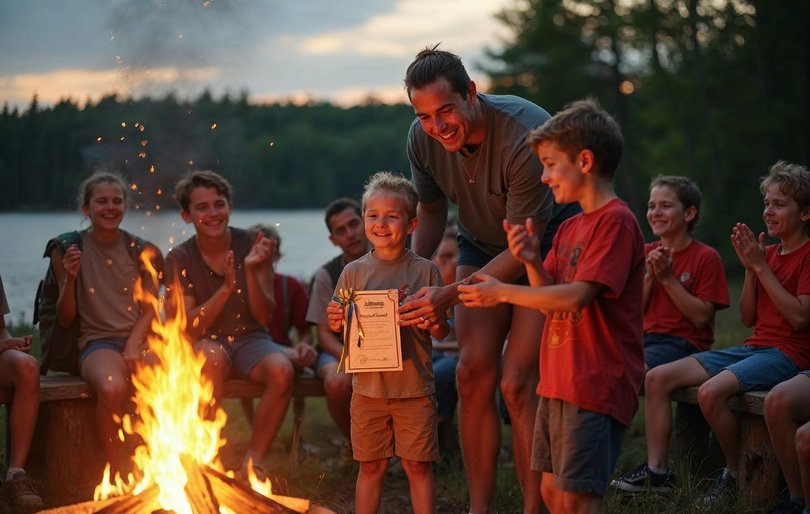
Run skit night like a stage show with a clock: sign up groups a day ahead, cap each skit at three minutes, appoint one MC, and set the order before anyone walks to the stage. With 10–14 cabin skits plus a couple of songs, that keeps the whole night near 45 minutes.
Scouting magazine (2017) puts the sweet spot for a full campfire program at 30 to 45 minutes, starting with high energy while the fire is high and winding down as it dies. Skit night follows the same arc.
- Build groups from the roster. Pull cabin and age-group lists from your camp registration software so every camper lands in a group, including midweek arrivals.
- Open sign-ups 24 hours early. Each group names its skit, cast and length. No surprise skits.
- Give a rehearsal block. Thirty minutes after rest hour is plenty.
- Pre-screen. The program lead watches each skit or hears a 30-second summary, counselor skits included.
- Set the order. Open loud and fast, put the youngest groups early before they fade, and close on something calm.
- Appoint an MC. One counselor introduces each group, starts the applause and fills gaps with a quick song.
- Use a time-up signal. A raised flashlight at three minutes, with the next group already on deck beside the stage.
In practice, here’s what that looks like. One overnight camp I worked with had a skit night that regularly ran 100 minutes. They added sign-ups, the three-minute flashlight and an on-deck spot by the fire. Next session: 14 cabins, two songs, 47 minutes. Same skits. Less waiting.
How Do You Keep Camp Skits Kind?
Keep camp skits kind by writing one rule everyone hears before the first sign-up: no put-downs. Scouting magazine’s 2017 test is a good one to borrow. Is the skit friendly, courteous, kind and clean? The same article says skits shouldn’t embarrass anyone and should stay away from religion, politics, race or ethnicity, and inside jokes.
My take? Turn that into a short pre-screening checklist:
- No targets in the audience. No jokes about a camper’s appearance, body, voice, clothes or family.
- No culture or disability humor. Skip accents, stereotypes and any bit where a disability is the joke. Some old folk skits hinge on an accent; rewrite the premise or drop it.
- No surprise volunteers. If a skit needs someone from the audience, swap in a counselor who’s in on it.
- No food waste or gross-out stunts.
- No inside jokes. If half the camp won’t get it, it’s not a skit. It’s a staff meeting.
Counselor skits need the closest look. Staff have the most stage time and the most power in the room, and a teasing line from a 19-year-old lands harder on a 9-year-old than the counselor expects.
Want a faster gut check? On Scouting, Scouting America’s official blog (2012), suggests imagining the skit is being recorded. Would the performers be fine with their grandparents watching it?
If something slips through, stop it. A calm “Let’s pause that one and bring up the next group” from the MC, then a quiet conversation afterward, protects the camper without shaming anyone.
How Do You Help Shy Campers Take Part?
Help shy campers take part by offering roles that don’t need a solo spoken line: sound effects, a statue, a crowd member, or a narrator reading from a card. Let each camper choose a spot on a ladder from backstage to center stage, and never force anyone to perform.
The payoff is real. The American Academy of Pediatrics (updated 2023) notes that research shows play can improve kids’ abilities to plan, organize, get along with others and regulate emotions, and that make-believe lets them try out different roles. A two-minute skit is pretend play with an audience.
A simple role ladder:
- Crew: runs the flashlight cue
- Sound effects: off to the side, still part of the group
- Background: a statue, a tree, a crowd member
- Group line: one line said with everyone else
- Speaking role: a short line of their own
Warm up first. A round of summer camp icebreaker ideas at the start of rehearsal gets nervous kids laughing before anyone mentions the stage. And I’d let a camper move up one rung per night, not three.
How Do Skits Fit Into Your Season Plan?
Treat skits like any other signature program: build a skit bank before staff training, schedule skit night on the same evening each session, and teach counselors the kindness rule during orientation. Returning campers will plan their cabin skit weeks ahead when they know exactly when it’s coming.
Keep the skit bank to one page, rewrites included, and put skit night on the calendar parents see. Planning like this is part of how to run a summer camp well, season after season.
FAQ
What are some good skit ideas for camp?
Invisible Bench, Echo Canyon, Wax Museum, Human Machine and Redo the Scene are reliable picks because they need no props and work for most ages. Let campers write the lines.
How long should camp skits be?
Keep each skit under three minutes, and closer to one or two at a campfire. The whole program should land near 30 to 45 minutes.
What are some good skits for teenagers?
Teens do best with skits they can rewrite. Redo the Scene, Channel Surfing and Instant Replay let them invent the styles and channels. Hold them to the same three-minute limit and no-put-downs rule.
What makes a camp skit inappropriate?
A skit crosses the line if it targets someone in the audience, mocks appearance, culture, religion or disability, embarrasses a volunteer, or relies on inside jokes. Pre-screen every skit and stop any that slip through.
Should counselors perform skits too?
Yes. Campers copy what staff do, so a kind, silly counselor skit sets the tone for the whole night. Screen staff skits exactly like cabin skits.
Conclusion
Good camp skits come from a plan, not a script. Place them where they fit: campfire, assembly, skit night or a rainy afternoon. Pick no-props folk premises and let campers write the lines. Run the night with sign-ups, a three-minute cap and an MC. Screen every skit against a no-put-downs rule. And give the quiet campers a rung on the ladder.
Do that, and 9:15 p.m. looks different: a 45-minute show, every cabin on stage, nobody the punchline. This week, write your kindness rule and start your skit bank.