


Key Takeaways
- Teach five skills: flag pulling, throwing, catching and routes, snaps and hand-offs, and footwork.
- Keep groups small (two to four kids) so nobody waits in a long line.
- A 60-minute practice runs belts-on tag, skill stations, two water breaks and a scrimmage.
- Same drills for every age; change the distance, speed and number of rules.
- Rotate quarterback and center so every kid touches the ball.
It’s 5:45 on a Tuesday. Ten kids, three of them wearing flag belts upside down, one ball, and a scrimmage where the same two players touch it every snap. You signed up because nobody else would, and now you need flag football drills that work for a seven-year-old and an eleven-year-old on the same field. So how do you fill an hour without losing half the team by minute twenty?
Flag football drills are short, repeatable practice activities that teach the core skills of the non-contact game, such as pulling flags, throwing, catching, running routes, snapping and handing off, in small groups so every player gets frequent touches. Below you’ll find twelve of them, a timed plan, and four plays for the fall 2026 season.
What Are the Best Flag Football Drills for Youth Teams?
The best flag football drills for youth teams are short, small-group activities that cover five skills: flag pulling, throwing, catching and route running, snaps and hand-offs, and footwork. Run each for five to eight minutes in small groups, then finish with a small-sided game.
| Drill | Skill | Setup | Time | Age notes |
|---|---|---|---|---|
| Belt Tag | Flag pulling, belt awareness | 20×20-yard grid, everyone wears a belt | 5 min | All ages; start here every practice |
| Lane Pull | Breaking down, two-hand pull | Two cones 5 yards apart, runner vs. defender | 6-8 min | 5-7: walk it first |
| Mirror Shuffle | Defensive shadowing | Pairs, 3-yard box, one leads and one copies | 4-5 min | All ages |
| Hip Turn Dodge | Avoiding pulls without guarding | 5×5-yard box, ball carrier vs. defender | 5 min | 8+ |
| Kneeling Partner Throws | Throwing motion | Pairs on both knees, 5 yards apart | 5 min | 5-7: 3-4 yards |
| Target Toss | QB accuracy | Hoop or trash can 8-15 yards out | 5-6 min | Move closer for younger kids |
| Diamond Catch and Tuck | Catching with hands, securing the ball | Coach tosses high, chest and low | 5 min | All ages |
| Cone Route Walk | Slant, out, hitch, go | Cones mark each break point | 6-8 min | 5-7: two routes only |
| Snap Pairs | Center-to-QB snap | Pairs, shotgun depth 3-4 yards | 4-5 min | All ages |
| Hand-Off Lines | Clean exchanges | QB in middle, two lines of runners | 5-6 min | 8+: add a pitch |
| Cone Box Cuts | Footwork, plant and cut | Four cones in a 5-yard square | 5 min | All ages |
| 3v3 Mini Game | Everything in a game | Half-width field, short end zones | 10-15 min | Swap to 5v5 for 8+ |
My pick for the first practice? Belt Tag. It’s loud, and nobody stands still.
How Do You Teach Flag Pulling to Kids?
You teach flag pulling by breaking it into four cues: run to the ball carrier’s hip, chop your feet to slow down, keep your eyes on the belt, and grab with an open hand before pulling hard. Practice it at walking speed first, then jogging, then full speed. Flag pulling drills only work when kids slow down before they reach the runner.
Most missed flags come from one mistake — kids sprint in and dive at the belt.
- Aim for the hip, not the ball. The ball moves; the belt doesn’t.
- Chop the feet. Short, quick steps two yards out. Coaches call it breaking down.
- Eyes on the belt. Not the face, not the ball.
- Grab, then rip. Close on the flag and pull it away from the body.
Lane Pull is where these cues stick. The runner jogs through a five-yard cone lane; the defender breaks down and pulls. Shrink the lane if every runner gets past, widen it when defenders win every rep.
Hip Turn Dodge teaches the other side: beat the defender with footwork alone. Hands near your own belt is flag guarding, a penalty in most leagues.
If your players keep diving, make them freeze and hold the flag up after each pull.
What Does a 60-Minute Flag Football Practice Plan Look Like?
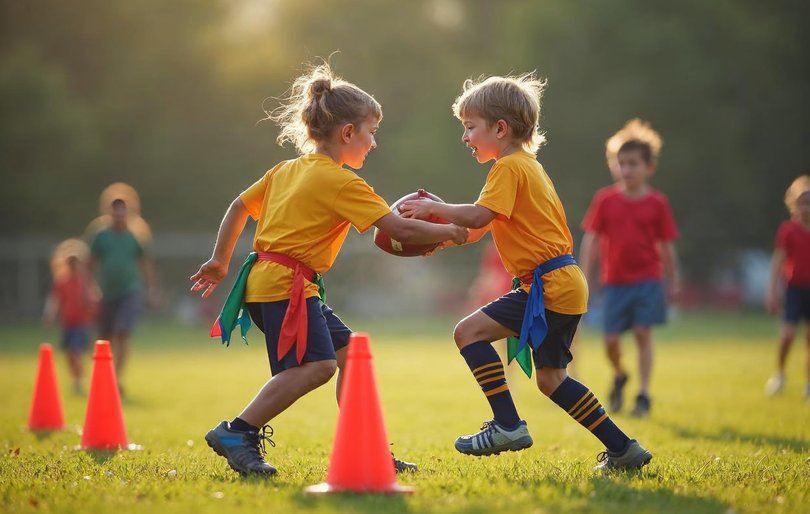
A 60-minute flag football practice plan opens with belts-on tag, moves into footwork and flag pulling, rotates small groups through skill stations, builds in two water breaks, and ends with a scrimmage and huddle. Keep every block under ten minutes except the game. Kids should spend most of the hour moving, not listening.
| Minutes | Activity | Coach cue |
|---|---|---|
| 0-5 | Belt Tag as kids arrive | “Belts on, flags on your hips” |
| 5-10 | Cone Box Cuts and Mirror Shuffle | “Short steps at the cone” |
| 10-18 | Lane Pull | “Chop, eyes on the belt, rip” |
| 18-20 | Water break | Check belts and shoelaces |
| 20-35 | Three stations, 5 min each: Kneeling Throws or Target Toss / Cone Route Walk / Snap Pairs and Hand-Off Lines | Rotate on the whistle |
| 35-40 | Diamond Catch and Tuck | “Hands first, then tuck” |
| 40-42 | Water break | Ask who’s tired or hurting |
| 42-56 | Scrimmage: run this week’s two plays | Every kid plays QB or center once |
| 56-60 | Huddle | One thing each player did well |
Three stations need three adults. Alone? Run one station at a time.
The water breaks aren’t padding. Cincinnati Children’s pediatrician Alissa Conde, MD, advises in a 2022 practice-safety guide that kids take a break every 20 minutes and be allowed water whenever they ask. Pair that with a moving warm-up and belts that fit, and you’ve covered most of the basics for preventing youth sports injuries at practice.
What to pack: belts plus spares, 12-16 cones, a youth-size ball per pair, pinnies, a target bucket and water.
How Should Flag Football Drills Change for Ages 5-7, 8-10 and 11-12?
Flag football drills stay the same across ages; what changes is distance, speed, group size and how many rules you add. Five-year-olds need belts, catching and flag pulling at walking speed. Eight-year-olds can handle routes and hand-offs. By 11 and 12, players are ready to read the defense and run a small playbook.
| Age group | Focus | Adjust | Plays to install |
|---|---|---|---|
| 5-7 | Belts, flag pulling, catching, running the right way | Short distances, walk-throughs, tag games, 3v3 | One run, one pass |
| 8-10 | Routes, hand-offs, snaps, breaking down | Full-speed reps, 5v5 scrimmage | Three to four |
| 11-12 | Reading defenders, timing, rushing the QB | Longer throws, live rushers at legal depth | Five to six |
With the youngest group, if a five-year-old can’t repeat the rule back to you, it’s too long. With 11- and 12-year-olds, make drills competitive — count flag pulls, track completions — because walk-throughs bore them fast.
What Are Simple Youth Flag Football Plays for Beginners?
Simple youth flag football plays use one clear read, short routes and a hand-off or two, so kids remember them under pressure. Four cover most rec games: a sweep, a quick slant, a flood and a center hook. Walk them through, then run them every scrimmage.
- Sweep. The QB hands off to a runner who heads wide toward the sideline while receivers run deep to pull defenders away. One exchange, one direction.
- Quick Slant. Two receivers take three steps, then cut toward the middle. The QB throws to whoever opens first.
- Flood. Three receivers go to one side at three depths: short out, eight-yard curl, deep. Older kids learn to read short to deep.
- Center Hook. The center snaps, runs five yards and turns back to the QB. Defenders forget the center. Check your league’s rules — in many 5-on-5 formats the center is an eligible receiver.
Two plays that work beat eight nobody remembers.
How Do You Coach Flag Football So Every Kid Touches the Ball?
You coach flag football well by rotating every position, keeping instructions under 15 seconds, and enforcing the no-contact rules from the first practice. NFL’s Play NFL Flag overview describes the game as a non-contact, 5-a-side version of football, and its rules note the QB may not run beyond the line of scrimmage — so hand-offs and passes carry the offense.
- Rotate QB and center. Every kid snaps and throws once per scrimmage.
- Keep talks short. Kneel, say one thing, play.
- Teach no-contact from day one. No blocking, no stiff-arms, no hands near your own flags.
- Water on the schedule. Don’t wait for complaints.
- Praise effort by name. “Nice chop, Jordan” beats “good job, guys.”
The rule behind soccer drills for kindergarten applies here too: more touches beats more talking.
Here’s how it tends to play out. A coach runs full-team scrimmages for three weeks and the two fastest kids score every touchdown. Switch to rotating QBs and two 3v3 games side by side, and by week five the quiet kid at center is catching hooks.
If your own kid is on the roster, learning how to coach your child’s sports team without favoring them is a skill of its own.
How Can Leagues Help Volunteer Flag Football Coaches?
Leagues help volunteer flag coaches most by handing them a written practice plan, a stocked equipment bag, a short preseason clinic, and a clear practice schedule before week one. A coach who knows the drills runs a calmer practice and comes back next season.
Demand is growing. Aspen Institute’s Project Play reports that in 2022, 277,000 more children ages 6-12 played flag than tackle — a reversal from a decade earlier, when tackle led. More teams means more first-time coaches.
Most leagues already recruit and train volunteer coaches. Add a one-page flag plan and a 30-minute field walk-through, and a nervous parent knows exactly what happens at 5:45.
If you’re still working out how to start a youth sports league, plan the coach clinic and equipment bags from season one.
Good sports management software handles rosters, team assignments and practice scheduling in one place, so coaches spend Tuesday evenings on the field instead of in group texts.
FAQ
What are some good drills for flag football for 5-year-olds?
Belt Tag, Lane Pull at walking speed, Diamond Catch and Tuck, and a 3v3 mini game, five minutes each.
What are some good drills for 10U flag football?
Cone Route Walk, Hand-Off Lines, Snap Pairs and full-speed Lane Pull, plus a 5v5 scrimmage with rotating QBs.
What are some good drills for 12U flag football?
Competitive Target Toss, Hip Turn Dodge, and scrimmages with a legal rusher where players call plays.
How do you teach flag football to beginners?
Start with belts and flag pulling, then catching, then one run play and one pass play. Walk through everything first.
Can you block in flag football?
Not in most youth leagues. The game is non-contact, so players screen with position, never hands or bodies. Check your league’s rulebook.
Conclusion
Good flag football drills don’t need a thick playbook. Start with Belt Tag, teach flag pulling at walking speed, rotate small groups through throwing, routes and snaps, and end with a scrimmage where every kid plays quarterback once. Print the 60-minute plan, pack the belts, and run it Tuesday.