


Key Takeaways
- Split the team into three small groups so nobody waits in line.
- Run each drill for five to seven minutes, then rotate.
- A 50-minute plan: warm-up game, three stations, base running, team game, huddle.
- Helmets on anyone holding a bat or running bases; use softer balls.
- Show it, don’t explain it.
Last updated: October 2026
It’s 9:02 on a Saturday. You’ve got one tee, one bucket of balls, and twelve kids in a line that stretches to the dugout. Two are digging for worms near second base. One is wearing his glove as a hat. Good t-ball drills fix most of that — with more tees, smaller groups and shorter games, not more discipline. So how do you keep a dozen four- to six-year-olds busy for a full practice?
T-ball drills are short, game-based activities for 4- to 6-year-olds that teach the basics of baseball (swinging off a tee, running the bases, fielding ground balls and throwing at a target) in small groups, so every child gets constant turns instead of waiting in one long line. Below are ten of them, plus a timed plan you can run this spring.
What Are the Best T-Ball Drills for 4- to 6-Year-Olds?
The best t-ball drills for this age are short games played in groups of three or four, where every child swings, runs, scoops or throws within a minute. Cover batting off the tee, base running, fielding grounders, throwing at a target and ready position each week, then finish with one simple team game.
| Drill | Skill | Setup | Time |
|---|---|---|---|
| Tee Station Swings | Level swing, hand-eye contact | 3-4 tees spaced well apart, one adult each | 6-8 min |
| Hit to the Hoop | Aiming contact | Hula hoops 10-20 feet out in the grass | 5-6 min |
| Run Through First | Running past the bag | Home plate, first base, coach past the bag | 5 min |
| Race the Roll | Base path speed | Runner at home, helper at first | 5 min |
| Musical Bases | Base order | All four bases, kids jogging the diamond | 5 min |
| Ready Statues | Ready position | Open grass, gloves on | 3-4 min |
| Scoop and Dump | Two-hand ground balls | Lines of 3-4, a bucket behind each | 6 min |
| Glove Up, Glove Down | Catching glove position | Pairs with a helper tossing soft balls | 5 min |
| Step and Throw | Overhand throw at a target | Cones or plastic pins 10-15 feet away | 6 min |
| Team Touch | Playing the game | Full diamond, one batter, everyone else fielding | 8-10 min |
Some leagues call them tee ball drills. Same games. My pick for week one? Musical Bases.
How Do You Run Fun T-Ball Drills So Nobody Waits in Line?
You run fun t-ball drills by cutting the line, not the fun: use three or four small groups, a tee and a bucket for each, and a one-sentence rule a five-year-old can repeat back. Keep each game to five to seven minutes and switch before attention drops.
It’s the same rule behind good soccer drills for kindergarten — at this age, kids learn by touching the ball, not by watching someone else touch it.
Batting Drills
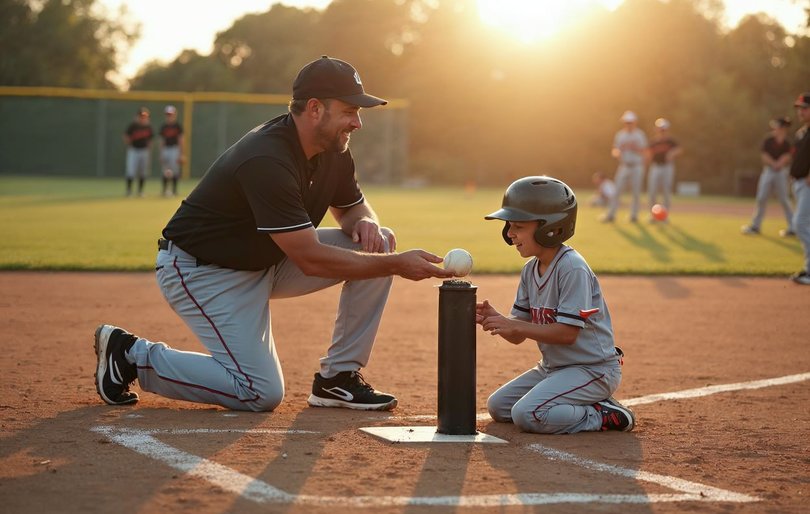
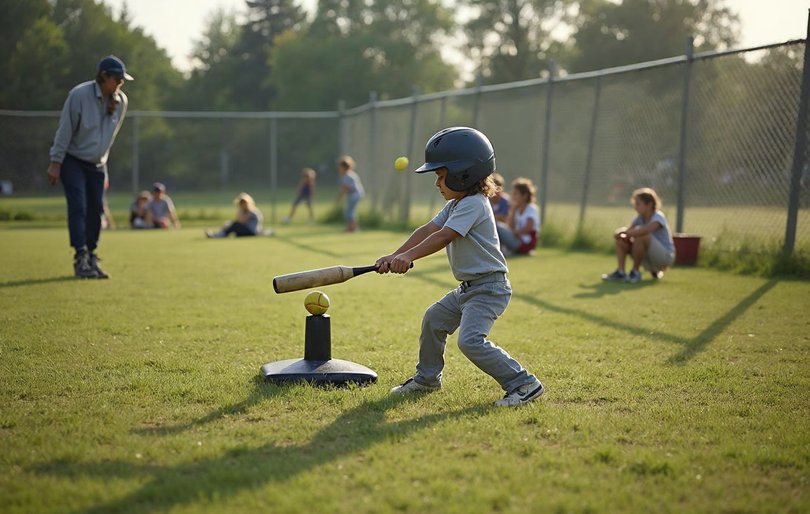
- Tee Station Swings: Three or four tees, at least 15 feet apart, each with a parent and a bucket of soft balls. Five swings into a fence or net, then switch.
- Hit to the Hoop: Lay hula hoops in the grass. Any ball that rolls through one gets a cheer.
Base Running Drills
- Run Through First: Each child swings off the tee, drops the bat in a hoop and sprints past first base toward you. Stand five steps beyond the bag so they don’t stop on it.
- Race the Roll: You roll a ball to a helper at first while the runner tries to beat it there. No outs.
- Musical Bases: Kids jog the bases in order while you clap. When the clapping stops, everyone freezes on the nearest base.
Fielding and Catching Drills
- Ready Statues: Shout “Ready!” and players freeze with feet wide, knees bent and glove open low. Admire the statues.
- Scoop and Dump: Roll soft grounders to a line of three. Scoop with the glove, cover with the other hand, run it to a bucket.
- Glove Up, Glove Down: A helper tosses softly. Above the belly, fingers up. Below it, fingers down.
Throwing Drill
- Step and Throw: Line up cones or plastic pins 10-15 feet away. Point the glove at the target, step with the opposite foot, throw.
Team Game
- Team Touch: One batter hits off the tee and runs the bases. Every fielder chases the ball, and all of them have to touch it before the runner reaches home. No outs, no score, no dandelion-picking in the outfield.
If kids keep piling on the same grounder in Team Touch, give each fielder a “zone” cone to start from.
What Does a 50-Minute T-Ball Practice Plan Look Like?
A 50-minute t-ball practice plan opens with a moving warm-up game, runs three six-minute stations led by parent helpers, adds base running and one team game, and closes with a huddle. Add two water breaks. Kids should spend most of it moving, not listening to you.
| Minutes | Activity | Coach cue |
|---|---|---|
| 0-5 | Musical Bases | “First, second, third, home” |
| 5-8 | Ready Statues | “Glove open, low” |
| 8-10 | Water break | Helmets out, helpers to stations |
| 10-28 | Three stations, 6 minutes each: Tee Station Swings, Scoop and Dump, Step and Throw | Whistle to rotate |
| 28-30 | Water break | Count heads |
| 30-36 | Run Through First, then Race the Roll | “Run past the bag” |
| 36-46 | Team Touch | “Everybody touches it” |
| 46-50 | Huddle, high fives, team cheer | Name one thing each child did well |
Got 45 minutes? Trim Team Touch to five. Got an hour? Add Hit to the Hoop as a fourth station.
How Should Parent Helpers Run the Stations?
Helpers need three rules, not a clinic:
- Stay at your station. Kids rotate; adults don’t.
- One cue only. Give each helper a single phrase, like “glove open, low.”
- Rotate on the whistle. Groups move clockwise, and the bat never leaves the batting station.
Recruit helpers before the first practice starts. Parents say yes to six minutes with a bucket of balls. “Coaching” scares them off.
How Do You Keep T-Ball Practice Safe?
You keep t-ball practice safe with three habits: helmets on any child holding a bat or running the bases, a marked swing zone around every tee, and softer balls. The American Academy of Pediatrics notes in its baseball and softball guidance (2012) that softer balls cut overall injuries from being hit by the ball.
- Helmets: On before a child touches a bat. Check the fit — a wobbly helmet slides over the eyes mid-swing.
- Swing zone: Ring each tee with cones. Only the batter and the helper go inside.
- Drop the bat: Teach “drop it in the hoop, then run.” A flung bat is the one thing you never want to see at tee-ball practice.
- Soft balls: Use reduced-impact or foam balls for every drill, including the throwing station.
At this age, how you prevent youth sports injuries is mostly routine: warm-up, water, gear that fits.
How Do You Handle Short Attention Spans at T-Ball Practice?
You handle short attention spans by talking for ten seconds, showing the drill once and then letting kids play. The American Academy of Pediatrics (2024) says children under six have short attention spans and that instruction should be limited, show-and-tell, and include playtime.
- Ten seconds, then go. Longer, and you’ve lost the kid in the back.
- Demo with a child. Five-year-olds copy each other faster than they copy adults.
- Use stories. “Statues” sticks. “Athletic stance” doesn’t.
- Switch early. When three kids are sitting in the dirt, the drill is over.
- Skip the score. The AAP also advises avoiding competition before age six. Nobody needs to win Team Touch.
In practice, picture a coach with one tee and a line of twelve: each kid gets maybe four swings all morning. Split the same team across three stations and every child swings several times per rotation. The worm-digging stops.
If your own child is on the roster, learning how to coach your child’s sports team without favoring them is its own skill.
What Should Happen at Your First T-Ball Practice?
Your first t-ball practice should teach names, the base path and bat safety, then get every child swinging within 15 minutes. Don’t cover everything. Fun and calm beats thorough.
- Name game (3 min): Name plus favorite animal.
- Walk the bases (3 min): Everyone walks first, second, third, home together. Then jog it.
- Helmet and bat rules (2 min): Show the swing zone and “drop it in the hoop.”
- Musical Bases and Ready Statues (8 min).
- Two stations (12 min): Tee Station Swings and Scoop and Dump.
- Team Touch, then huddle (11 min).
If kids run to third after they hit, lay a cone path to first and stand there waving them in.
How Can Leagues Help Volunteer T-Ball Coaches?
Leagues help new t-ball coaches most by handing them a printed plan, an equipment bag with several tees and soft balls, and a short preseason walk-through. A volunteer who arrives prepared runs a calmer practice and is far more likely to come back next season.
Little League’s Tee Ball curriculum is built as a 10-week plan with one practice and one game a week, drawing on up to 40 activities. Borrow that rhythm even if your league isn’t affiliated.
Most leagues already have a way to find and support volunteer coaches. Add a one-page tee-ball plan to that kit, and a nervous parent knows exactly what happens at 9:00.
If you’re still working out how to start a youth sports league, plan for extra tees and helmets in year one.
Good sports management software keeps rosters, practice times and coach-to-parent messages in one place, so volunteers aren’t hunting for phone numbers on Friday night.
FAQ
What age should you start t-ball?
Most leagues start tee ball at age 4 or 5 and run it through about age 6. Check your league’s age cutoff.
How do you teach a kid to play t-ball?
Teach one skill at a time through games: swing off a tee, run to first, scoop a rolling ball, throw at a target. Show it, keep it short, stop while they still want more.
What are good tee ball hitting drills for 5-year-olds?
Tee Station Swings, with three or four tees running at once, and Hit to the Hoop, where kids aim through hula hoops.
How long should t-ball practice be?
Plan 45 to 60 minutes. For most 4- to 6-year-olds, 50 minutes with two water breaks is about right.
What size bat does a t-ball player need?
Pick a short, light bat made for tee ball and approved by your league. A simple test: if your child can’t hold it straight out for a few seconds, it’s too heavy.
Conclusion
T-ball drills for four- to six-year-olds work when nobody waits: small groups, several tees, soft balls and games that last five to seven minutes. Print the 50-minute plan, recruit three parent helpers on day one, and run it this spring. You’ll know it’s working when the worm-digging stops.