

Key Takeaways
- Build every practice from six blocks: warm-up, ball control, skill work, game-like drills, scrimmage, cool-down.
- Save about a third of practice for game-like play.
- Work in pairs or threes with a ball per pair.
- Beginners serve from closer; experienced players get faster, scored drills.
- Teach two-foot landings to cut ankle sprains.
Last updated: October 2026
It’s 6:00, the gym is yours for 90 minutes, and twelve players are lined up behind you while you toss one ball at a time. Twenty minutes in, each kid has passed maybe five balls. A good volleyball practice plan fixes that before anyone touches a ball — it decides who’s where, for how long, doing what. So how do you fill 90 minutes so every player gets hundreds of contacts instead of a handful?
A volleyball practice plan is a timed, written schedule for one session that moves players from a dynamic warm-up through ball control, focused skill blocks and game-like drills to a scrimmage and cool-down, so every minute has a purpose and every player touches the ball as often as possible. This one is built for youth and rec teams, roughly ages 9 to 14.
What Is a Volleyball Practice Plan?
A volleyball practice plan is a minute-by-minute schedule that tells you what each player does, where, and for how long. Most plans use the same six blocks and change the drills inside them as the season goes on:
- Dynamic warm-up — movement, footwork, landing practice.
- Ball control — partner passing and pepper.
- Skill work — serving, passing, setting, the hitting approach.
- Game-like drills — small-sided games that combine skills and keep score.
- Scrimmage — 6v6 or smaller, with rotations.
- Cool-down — light stretching and a short huddle.
Write it down. Improvising costs minutes.
What Does a 90-Minute Volleyball Practice Plan Look Like?
A 90-minute volleyball practice plan runs nine short blocks: a 10-minute warm-up, ball control, four skill blocks, game-like play, a scrimmage, and a five-minute cool-down. Almost half the session is skill work, and the last half hour is game-like play, which is where young players learn to read the ball.
| Minutes | Block | What players do | Coach cue |
|---|---|---|---|
| 0-10 | Dynamic warm-up | Shuffles, lunges, jump-and-stick landings | “Land soft” |
| 10-20 | Ball control | Toss-and-pass, then pepper | “Platform to target” |
| 20-30 | Serving | Target serving in pairs | “Toss, step, swing” |
| 30-40 | Passing | Serve-receive in threes | “Feet first” |
| 40-48 | Setting | Triangle setting | “Hands up early” |
| 48-58 | Hitting approach | Footwork, then toss-and-hit | “Left-right-left” |
| 58-72 | Game-like drills | Queen of the Court, 2v2 or 3v3 | “Three contacts” |
| 72-85 | Scrimmage | 6v6 with rotations | “Call the ball” |
| 85-90 | Cool-down | Stretching, one high point each | Praise by name |
Add water breaks after serving and before the scrimmage. Lose time to a shared gym? Cut the setting block and let sets happen inside the games.
How Do You Run a 60-Minute Practice for Rec or Younger Teams?
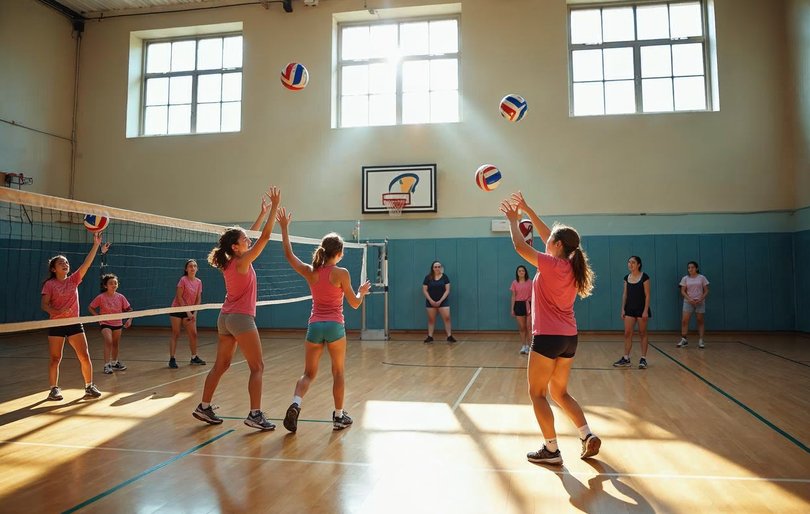
A 60-minute practice keeps the same blocks but merges a few: passing and setting become one pass-set-catch block, serving moves closer to the net, and a catch-and-throw game bridges skills and play. Fewer transitions matter, since every switch costs two or three minutes.
| Minutes | Block | What players do |
|---|---|---|
| 0-8 | Dynamic warm-up | Shuffles, jump-and-stick landings |
| 8-16 | Ball control | Toss-and-pass |
| 16-24 | Serving | Underhand, from inside the end line |
| 24-34 | Pass-set-catch | Threes: pass, set, catch |
| 34-42 | Newcomb to volleyball | Catch and throw, then add one bump |
| 42-55 | Small-sided games | 3v3 or 4v4, short court |
| 55-60 | Cool-down | Stretch and huddle |
If your players can’t get a serve over the net yet, move them in until most serves land. Confidence first. Distance later.
How Do You Build Your Own Volleyball Practice Plan Template?
Build a volleyball practice plan template by fixing the six blocks, setting a time ratio for each, then swapping drills in and out. USA Volleyball’s lesson plans follow a similar logic: gamelike drills, a net or a rope substitute, combined skills like pass-set-hit, and score kept by the players.
Here’s the ratio I’d start with:
| Block | Share of practice | 60 min | 90 min |
|---|---|---|---|
| Warm-up | 10-15% | 8 | 10 |
| Ball control | 10-15% | 8 | 10 |
| Skill work | 30-45% | 18 | 38 |
| Game-like drills and scrimmage | 30-35% | 21 | 27 |
| Cool-down | 5-10% | 5 | 5 |
Then fill it in:
- Pick one focus skill and write it at the top.
- Choose one drill per block that feeds that skill.
- Add a score to every drill after the warm-up. “Ten passes to target” beats “keep passing.”
- Review afterward. Circle what worked, cross out what dragged, reuse the sheet.
Which Volleyball Drills Should Go in Your Practice?
The best volleyball drills for beginners and youth teams are simple, run in pairs or threes, and repeat the same contact many times a minute. Pick one or two per block from the table, and give each drill a goal players can count out loud.
| Drill | Skill | Setup | Players | Time |
|---|---|---|---|---|
| Jump-and-stick | Warm-up, landing | Jump, land on both feet, hold three seconds | Whole team | 3 min |
| Toss-and-pass | Forearm passing | Partner tosses underhand; passer bumps it back | Pairs | 6-8 min |
| Pepper | Ball control | Pass, set, controlled hit, repeat | Pairs | 6-8 min |
| Target serving | Serving | Aim at hoops or cones in the far court | Pairs | 8-10 min |
| Short-court serving | Serving (beginners) | Start 10-15 feet in; step back after three in | Pairs | 6-8 min |
| Serve-receive threes | Passing | Serve, pass to a target, rotate | Threes | 10 min |
| Triangle setting | Setting | Set around a triangle; don’t let it drop | Threes | 6-8 min |
| Approach and catch | Hitting footwork | Run the approach, jump, catch a high toss | Lines of three max | 6 min |
| Toss-and-hit | Attacking | Partner tosses near the net; hitter swings | Pairs | 8 min |
| Newcomb to volleyball | Game sense (beginners) | Catch-and-throw over the net; add one contact per round | 3v3 or 4v4 | 8 min |
| Queen of the Court | Game-like play | Small teams challenge the winners; win a rally to stay | 2v2 or 3v3 | 12-15 min |
My pick for week one? Toss-and-pass and Newcomb. They get beginners rallying before they can serve.
How Do You Keep Every Player Touching the Ball?
You keep every player touching the ball by shrinking groups and multiplying balls: work in pairs or threes, give every pair its own ball, and never let a line grow past three players. One coach feeding one long line is the slowest drill in volleyball.
- A ball per pair. Borrow extras from the school.
- Use the whole gym. Pairs pass along the walls.
- Rope for extra nets. Tie it between two chairs.
- Let players toss. Your arm is the bottleneck.
- Count contacts. “First pair to 25” doubles the pace.
In practice, it tends to play out like this: a hypothetical 12U rec coach swaps one coach-toss line for six pairs and three Queen of the Court games. Same gym, same 90 minutes — but each player goes from a few contacts per block to dozens.
How Should You Adjust Practice for Beginners vs Experienced Players?
Keep the same blocks for both groups and turn the difficulty dials instead: distance, speed, ball height, and how much catching is allowed. The American Academy of Pediatrics’ HealthyChildren.org (2024) says most kids are ready for more complex sports by ages 10 to 12, with the focus still on skill development, fun, and participation.
| Dial | Beginners | Experienced |
|---|---|---|
| Serving | Underhand, closer to the net | Overhand, to zones |
| Passing | Partner tosses | Live serves, scored |
| Setting | Self-toss and set | Set off a pass |
| Hitting | Approach and catch | Toss-and-hit |
| Games | Newcomb, short-court 3v3 | Queen of the Court, 6v6 |
Growth spurts can scramble a 12-year-old’s coordination for a while. Give it time.
How Should Practices Progress Through the Season?
Add one new skill layer every two weeks while keeping the same daily blocks. Players learn faster when the structure stays familiar and only the drills inside it change.
| Weeks | Focus | Drills to add |
|---|---|---|
| 1-2 | Ball control, underhand serve | Toss-and-pass, short-court serving, Newcomb |
| 3-4 | Setting, three contacts | Triangle setting, pepper, serve-receive threes |
| 5-6 | Hitting approach | Approach and catch, toss-and-hit |
| 7+ | Game play | Queen of the Court, 6v6 scrimmage |
With two practices a week, I’d make the first skill-heavy and the second game-heavy.
How Do You Keep Volleyball Practice Safe?
You keep volleyball practice safe with a dynamic warm-up, two-foot landing practice, and a firm rule about staying on your side of the net. Ankle sprains are the most common acute volleyball injury, making up as much as half of all injuries among indoor players, according to a review in the British Journal of Sports Medicine (2006).
That review found about half of those sprains happen when a blocker lands on an attacker’s foot near the net. It also reported that training approach, takeoff, and landing technique alongside balance work cut ankle sprains. So the jump-and-stick drill isn’t filler. It’s prevention.
The American Academy of Orthopaedic Surgeons’ OrthoInfo adds a few basics:
- Warm up first. Cold muscles get hurt more easily.
- Wear the right gear. Supportive court shoes and knee pads.
- Watch the shoulders. Cap overhead reps for younger players.
Most of how to prevent youth sports injuries comes down to season-long routine: water breaks, rest days, and a coach who notices a limp early.
How Can Leagues Help Volunteer Volleyball Coaches?
Leagues help volunteer volleyball coaches most by handing them a written plan, a stocked ball cart, and a confirmed gym schedule before the first practice. A coach who arrives knowing the court, the time slot, and the first three drills runs a calmer session and is more likely to come back next season.
Most clubs already have a process to recruit and train volunteer coaches. Add this plan to the preseason clinic and walk new coaches through one practice on a real court.
If you’re still working out how to start a youth sports league, plan gym time and equipment from season one — shared courts fill up fast.
Good sports management software keeps rosters, court schedules, and coach-to-parent messages in one place, so volunteers aren’t chasing gym times through group texts.
FAQ
How long should a youth volleyball practice be?
Sixty minutes for rec and younger teams. Ninety for middle school and club teams.
What are good volleyball warm up drills?
Shuffles, lunges, and jump-and-stick landings, then toss-and-pass and pepper.
How can players practice volleyball at home?
Pass or set against a wall, and rehearse approach footwork without a ball.
What should players wear to volleyball practice?
Court shoes with ankle support, knee pads, athletic shorts, and a water bottle.
Conclusion
A volleyball practice plan doesn’t need to be fancy. Fix the six blocks, set your time ratios, work in pairs and threes with a ball for each pair, and save the last third of the session for game-like play. Print the 90-minute or 60-minute version, add one skill layer every two weeks, and teach two-foot landings from day one. Your players will get more touches in one practice than they used to get in three.