

Key Takeaways
- Sort drills by skill: hitting, fielding, throwing and catching, base running, and pitching basics.
- Run three stations at once so no child waits more than a minute or two.
- The same drill gets faster and more game-like from age 7 to age 12.
- Pitch Smart caps daily pitches at 50, 75, and 85 for ages 7-8, 9-10, and 11-12.
- Talk in 30-second bursts, keep score, and rotate every 10 minutes.
Last updated: October 2026
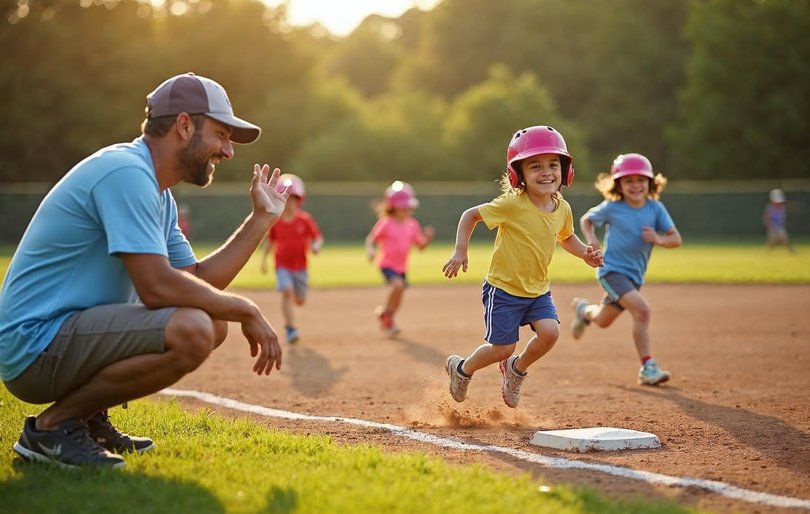
It’s your first practice. One kid is hitting, one is pitching, and ten are scattered across the outfield doing cartwheels. Forty-five minutes in, each player has had maybe eight swings. Good baseball drills for kids fix this by splitting the team into small groups that all work at once. So how do you fill 90 minutes so every player is busy the whole time?
Baseball drills for kids are short, repeatable activities that teach one skill at a time — hitting, fielding, throwing and catching, base running, or pitching basics — to players roughly 7 to 12, run in small groups so every child gets dozens of reps instead of waiting in line. This guide covers coach-pitch through Little League Majors. (Younger players need tee-ball games, which work differently.)
What Are the Best Baseball Drills for Kids?
The best baseball drills for kids teach one skill, use small groups, and pack in as many reps as possible. Pick two or three per skill and rotate them through stations. These 12 cover a full season for ages 7 to 12, from coach-pitch through Majors.
| Drill | Skill | Setup | Reps/Time | Ages |
|---|---|---|---|---|
| Tee Ladder | Hitting | Three tees: high, middle, low | 10 swings per tee | 7-12 |
| Side Soft Toss | Hitting | Coach kneels to the side, net in front | 2 rounds of 10 | 7-12 |
| Color Call | Hitting, pitch recognition | Front toss behind an L-screen, balls marked with two tape colors | 15 pitches | 9-12 |
| Alligator Grounders | Fielding | Partners 15 feet apart, rolled balls | 15 each | 7-10 |
| Knee Short Hops | Fielding | Kneeling partners, 10 feet apart | 15 each | 7-12 |
| Fly Ball Call | Fielding, communication | Two fielders, coach tosses between them | 10 per pair | 9-12 |
| Hoop Target Throws | Throwing accuracy | Hula hoop on the ground near a base | 10 throws | 7-10 |
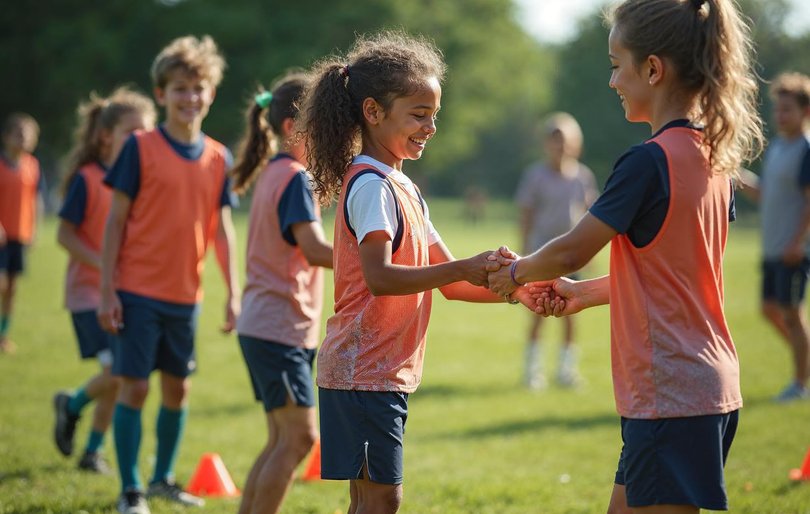
| Catch to 21 | Throwing and catching | Partners; chest catch = 2 points, anywhere else = 1 | First to 21 | 7-12 |
| Four Corners | Quick release | Four bases or cones in a square | 3 minutes | 8-12 |
| Run Through First | Base running | Batter’s box to first base | 5 sprints | 7-12 |
| Beat the Ball | Base running and relays | Runner circles bases while fielders throw around the horn | 6-8 rounds | 9-12 |
| One-Knee Throws | Pitching basics | Throwing-side knee down, partner 30 feet away | 15 throws, max | 9-12 |
My pick for week one? Catch to 21. It teaches two-hand catching, it’s competitive, and kids beg for it.
How Should Baseball Drills for Kids Change From Age 7 to 12?
Baseball drills for kids keep the same skills from 7 to 12, but the speed, distance, and decision-making go up. Seven-year-olds need contact, two-hand catches, and running through first. By 11 or 12, the same drills add live pitching, cutoffs, and game situations. Move up only once a group handles the current version cleanly.
| Age band | Typical format | Drill focus | Adjust it like this |
|---|---|---|---|
| 7-8 | Coach-pitch | Contact, two-hand catches, running through first | Tees, soft toss, short throws, rolled grounders |
| 9-10 | Kid-pitch begins | Fly balls, throwing footwork, base running reads | Add Fly Ball Call, Four Corners, One-Knee Throws |
| 11-12 | Majors-style | Relays, cutoffs, pitch recognition | Faster feeds, Color Call, live-runner Beat the Ball |
If your 9-year-olds still drop easy throws, stay with Catch to 21 another week. Rushing to live pitching doesn’t help anyone.
How Do You Run Hitting, Fielding, Throwing and Base Running Drills?
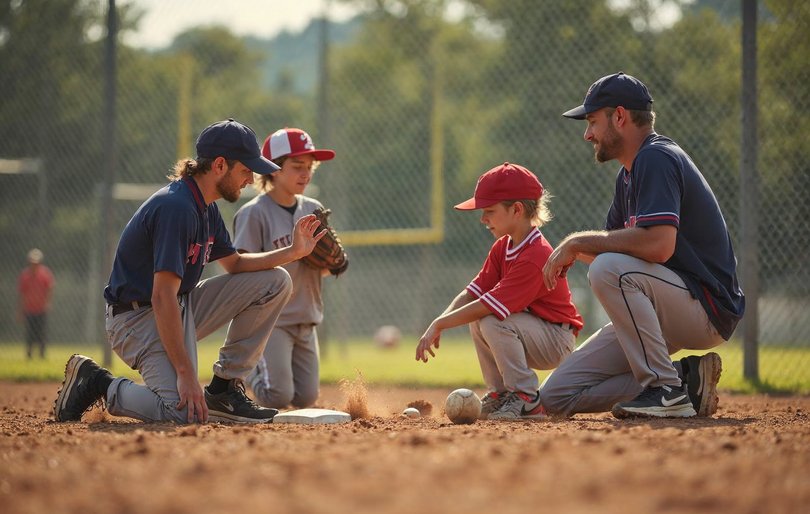
Run each drill with one coaching cue, a fixed rep count, and a fast rotation. Kids remember a single phrase, not a mechanics lecture. Give the cue once, demonstrate it, then let them work — and correct one player at a time while the rest keep going.
Hitting
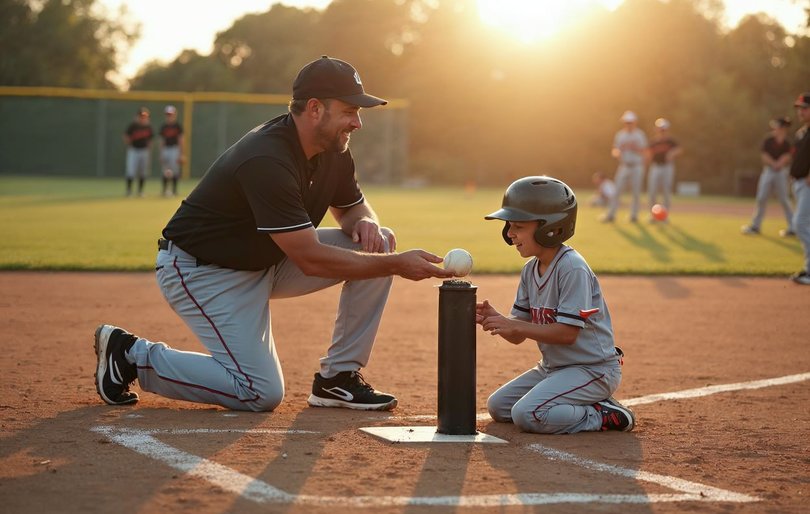
- Tee Ladder: Move the tee up, down, and across the plate. Cue: “Eyes on the ball until it’s gone.”
- Side Soft Toss: Toss from a knee, slightly in front of the hitter, into a net. Cue: “Hit it back past me.”
- Color Call: Call a tape color; the hitter swings only at that color.
Fielding
- Alligator Grounders: Glove low and open, throwing hand closing on top like jaws. Cue: “Glove on the dirt.”
- Fly Ball Call: Whoever yells “Ball! Ball!” takes it; the other backs off. Use soft training balls with younger groups.
Throwing, Base Running and Pitching Basics
- Hoop Target Throws and Four Corners: Step toward the target, throw, follow through. Count clean throws as a team.
- Run Through First: Sprint past the bag, eyes on the first-base coach.
- Beat the Ball: One runner circles the bases while fielders throw to each base in order. First to finish wins.
- One-Knee Throws (9-12): A clean arm path without the leg kick. Cap it at 15 throws.
What Does a 90-Minute Baseball Practice Plan Look Like?
A 90-minute baseball practice plan runs a warm-up, a throwing progression, three rotating skill stations, a team defense block, and a short scrimmage. Little League University recommends fast-moving stations so several drills run at once, and warns against hitting to one kid while the rest do nothing.
Here’s a plan for 12 players and three adults. The timings are mine, not a league rule.
| Minutes | Activity | Notes |
|---|---|---|
| 0-10 | Dynamic warm-up | Jog, skips, lunges, arm circles |
| 10-20 | Throwing progression | Knees, feet, step back, then Catch to 21 |
| 20-23 | Water and quick talk | One goal for today |
| 23-33 | Station rotation 1 | Hitting / Fielding / Base running and throwing |
| 33-43 | Station rotation 2 | Groups of four rotate clockwise |
| 43-53 | Station rotation 3 | Everyone has done all three |
| 53-58 | Water break | Check arms and pitch counts |
| 58-73 | Team defense | Fly Ball Call, then Beat the Ball |
| 73-87 | Situational scrimmage | Coach-pitch for 7-8s; kid-pitch, counted, for older groups |
| 87-90 | Huddle | One shout-out per player |
What to pack: tees, a net, two buckets of balls, throw-down bases, a hula hoop, an L-screen, soft training balls, water, and a pitch count sheet.
If you only have two adults, run two stations and put the third group on a self-run drill like Catch to 21.
How Many Pitches Can Kids Throw, and How Much Rest Do They Need?
Kids aged 7 to 12 should stay under a daily pitch cap and rest according to how many pitches they threw. MLB and USA Baseball’s Pitch Smart guidelines for ages 9-12 set a daily max of 75 pitches at ages 9-10 and 85 at 11-12, with rest days based on each outing’s count.
Those caps are for game pitches. I’d count bullpens and pitching drills too — the arm can’t tell the difference. Pitch Smart’s rest schedule for ages 9-12 looks like this:
| Pitches thrown in a day | Required rest |
|---|---|
| 1-20 | 0 days |
| 21-35 | 1 day |
| 36-50 | 2 days |
| 51-65 | 3 days |
| 66 or more | 4 days |
For ages 7-8, the Pitch Smart guidelines for ages 8 and under cap a day at 50 pitches, so the rest schedule tops out at two days. Pitch Smart also recommends at least four months off from throwing each year and playing other sports, which is the core of the debate over sport specialization at these ages.
Little League’s regular season pitching rules add two rules coaches miss:
- A player who catches four or more innings can’t pitch that same day.
- Nobody pitches three days in a row, regardless of count.
Arm care fits inside a broader plan for how to prevent youth sports injuries: warm up before throwing, stop any player who mentions elbow or shoulder pain, and stick to fastballs and changeups.
How Do You Keep Kids Engaged During Baseball Practice?
Keep kids engaged by talking less, scoring everything, and rotating before anyone gets bored. A 10-minute station feels short to a nine-year-old; 25 minutes of batting practice feels endless. Use names, praise effort out loud, and end with something fun.
- Talk in 30-second bursts. Longer, and the outfield starts drawing in the dirt.
- Turn drills into contests. Team totals work better than ranking kids against each other.
- Give everyone a job. On deck, in the hole, shagging — nobody sits.
- Rotate positions. At 7-10, every kid should try the infield and the outfield.
- Finish with a game. A scrimmage or Beat the Ball sends them home happy.
Here’s a hypothetical that plays out on a lot of fields. A 10U coach runs classic batting practice: one hitter, one coach pitching, eleven players waiting. In 30 minutes, each kid gets about 15 swings. Split the same 30 minutes into three hitting stations — tee, soft toss, front toss — and each player gets 50 or 60 swings. Same time. Four times the work.
If your own child is on the roster, learning how to coach your child’s sports team fairly is a separate skill. Treat them like every other player at practice.
How Can Leagues Help Volunteer Baseball Coaches?
Leagues help volunteer coaches by handing them a written practice plan, a stocked equipment bag, and a simple way to track pitch counts before the first practice. A coach who shows up with tees, a net, and a station plan runs a better session — and is far more likely to sign up again next spring.
Most leagues already have a process to recruit and train volunteer coaches. Add a 30-minute field clinic where coaches run the three stations themselves before spring 2027.
If you’re still working out how to start a youth sports league, build pitch-count tracking and an equipment checklist into your setup from day one.
Good sports management software keeps rosters, practice schedules, and coach-to-parent messages in one place, so volunteers can spend practice coaching instead of texting.
FAQ
What are some good drills to teach kids to catch a baseball?
Start with Catch to 21, Knee Short Hops, and Fly Ball Call with soft training balls. Each builds two-hand catching with plenty of reps and less fear of the ball.
What are some good baseball fielding drills for 10-year-olds?
Alligator Grounders, Fly Ball Call, Four Corners, and Beat the Ball cover grounders, fly balls, quick throws, and relays.
What should a 7 year old be able to do in baseball?
Most 7-year-olds can hit off a tee or coach pitch, catch a soft toss with two hands, throw toward a target, and run through first base. Expect a wide range of skill.
What are some good baseball hitting drills for 8-year-olds?
Tee Ladder and Side Soft Toss. Both deliver dozens of swings in minutes and let you fix one thing at a time.
Can kids do baseball drills at home?
Yes. Tee work into a net, wall-ball grounders with a rubber ball, and Catch to 21 with a parent all work in a backyard.
Conclusion
Baseball drills for kids work best when every player is moving at the same time. Pick drills by skill, run them in three stations, adjust for age, and count every pitch against Pitch Smart’s limits. Print the 90-minute plan, pack the tees, and run it at your next practice.